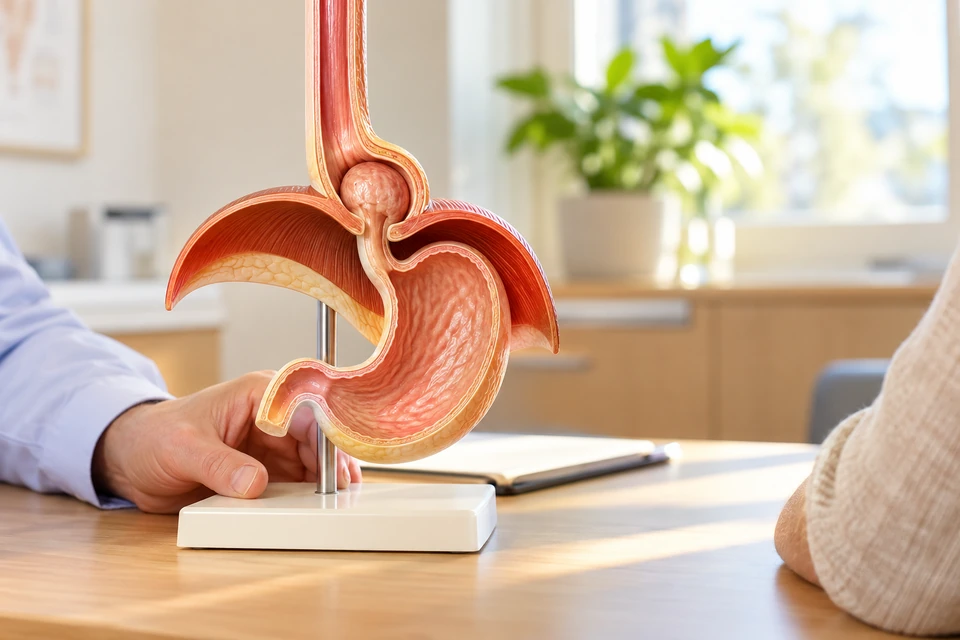
Understanding the different types
In a sliding hernia, the stomach–oesophagus junction moves upwards and reflux may occur. Paraesophageal hernias involve different degrees of stomach displacement beside the oesophagus. Symptoms can include fullness, swallowing difficulty, chest pressure or anaemia. Finding a hernia does not prove that it explains every symptom, particularly chest pain.
Assessment before considering repair
Endoscopy assesses the lining, while contrast swallowing studies or CT may clarify anatomy. Reflux monitoring and tests of oesophageal function can be useful when symptoms or the planned procedure require them. Previous surgery, anaemia, weight change and difficulty maintaining food intake are important parts of the assessment.
Observation, medicines and surgery
Observation may suit some people without troublesome symptoms. Acid-suppressing medicines can relieve reflux but do not restore the anatomy. Repair may be considered for significant mechanical symptoms, complications or confirmed reflux that remains troublesome. For an apparently asymptomatic large hernia, the balance between observation and elective repair needs individual discussion.
The principles of repair
Repair returns the displaced stomach to the abdomen and narrows the enlarged opening. A fundoplication or another supporting procedure may be added when appropriate. Mesh is not automatically required; evidence and individual anatomy inform that decision. The planned approach should account for tissue quality, hernia size and previous repairs.
Risks and possible functional changes
Risks include bleeding, infection, injury to nearby structures and clots. Swallowing difficulty, bloating, difficulty belching or vomiting, and persistent or recurrent reflux are also discussed. Hernias can recur, but a small imaging recurrence does not automatically require another operation. Health and nutritional status influence the overall risk.
Preparing for the operation
Bring existing investigations and an accurate medication list. Anaemia or poor nutrition may need attention before surgery. Fasting and medicine instructions should come from the treating team. Discuss changes to food texture, support at home and the criteria for returning to work, rather than relying on a fixed recovery timetable.
Eating and follow-up
Food texture is advanced according to the repair and recovery. Small bites, thorough chewing and unhurried meals may help. Persistent food sticking, inadequate fluid intake or significant weight loss need review. Follow-up considers swallowing and bloating as well as reflux, and medicines are adjusted according to an agreed plan.
Symptoms requiring urgent assessment
Sudden severe chest or upper abdominal pain, repeated unproductive retching, inability to swallow liquids or marked breathlessness requires urgent assessment. A large hernia can occasionally twist or become trapped. Chest pain should not simply be attributed to a known hernia, because cardiac and lung emergencies may cause similar symptoms.
This information is general. The cause of symptoms, appropriate investigations and treatment options are determined through individual assessment.
Medical references
- SAGES — Surgical treatment of hiatal hernias, 2024 guideline
- SAGES — Hiatal hernia guideline full text
- ASGBI, AUGIS and NHS — Hiatus hernia repair and surgery for heartburn
- Worcestershire Acute Hospitals — Laparoscopic hiatus hernia repair
- ACG — Clinical use of oesophageal physiological testing
- WSES — Management of complicated diaphragmatic hernia, 2023