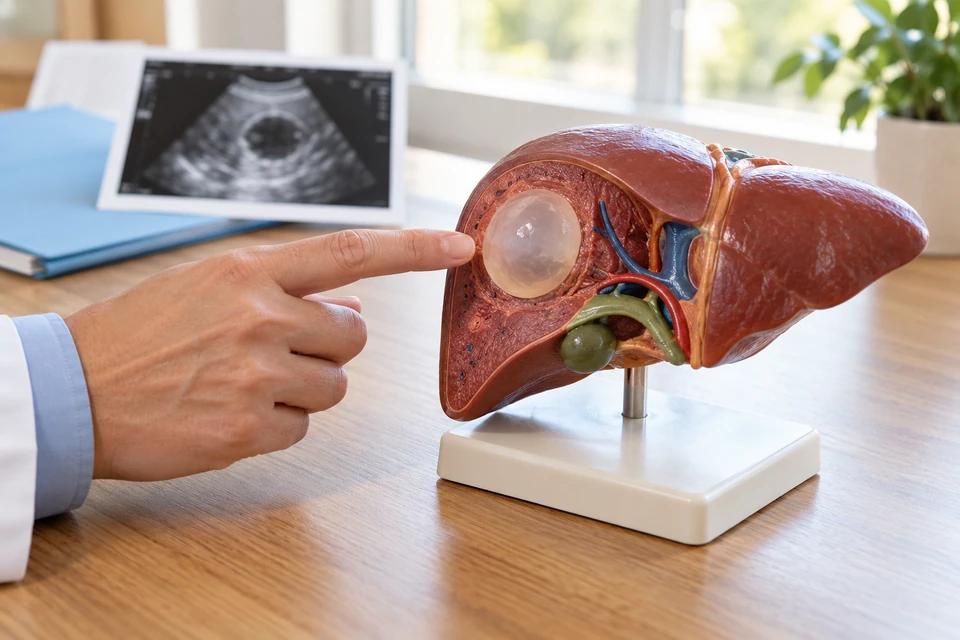
First establish the type of cyst
Simple liver cysts are often incidental benign fluid-filled lesions. Hydatid disease, polycystic liver disease and cystic tumours require different management. Diameter alone cannot determine treatment. Internal structure, wall characteristics, anatomy and symptoms matter, and the word cyst does not mean that every lesion can safely be drained in the same way.
Imaging and selected tests
Ultrasound is often the starting point, with CT or MRI for complex features such as septa, thick walls, solid areas or biliary connections. Exposure history and selected parasite tests may be relevant. Earlier images help assess change. An unexplained cyst should not undergo unplanned aspiration before important alternatives have been considered.
Observation of simple cysts
A confidently characterised, asymptomatic simple cyst often needs no intervention and may not require repeated short-interval imaging. If pain is present, establish whether the cyst actually explains it. Size alone does not prove causation. New symptoms or structural changes should lead to reassessment rather than automatic treatment.
Options for symptomatic simple cysts
Selected symptomatic simple cysts may be treated with aspiration plus sclerotherapy or surgical fenestration. Fenestration opens part of the cyst wall to reduce refilling, but it is not suitable for every cyst type. Aspiration alone may recur. Location, number, biliary relationships and confidence about symptom causation guide selection.
Why hydatid cysts are different
Hydatid disease is a parasitic infection managed according to cyst stage and complications. Options include medicines, selected controlled percutaneous procedures, surgery or observation of inactive disease. Biliary connections and rupture or infection alter the plan. Spillage and allergic reactions require specialist precautions; unplanned drainage is unsafe.
Surgical risks and preparation
Risks include bleeding, infection, bile leak, adjacent-organ injury and recurrence. Parasitic disease adds specific precautions and medicine monitoring. Preparation reviews liver function, other illnesses, medicines and previous interventions. The approach depends on location and diagnosis, and the expected effect on symptoms should be discussed without promising complete relief.
Results and follow-up planning
Follow-up reviews healing, any pathology, liver tests and symptoms. Hydatid disease may require longer imaging and drug-safety monitoring. Recurrent pain after simple-cyst treatment does not automatically prove recurrence. New imaging should be compared with earlier studies, and drains need clear care and removal instructions.
Symptoms needing urgent assessment
Sudden severe abdominal pain, fever, jaundice, persistent vomiting or marked deterioration needs prompt assessment. Rash with breathing difficulty, fainting or facial swelling in someone with hydatid disease requires emergency help. After treatment, report increasing distension, worsening pain or unexpected drainage and identify the known cyst type and medicines.
This information is general. The cause of symptoms, appropriate investigations and treatment options are determined through individual assessment.