Why it differs from a true hernia
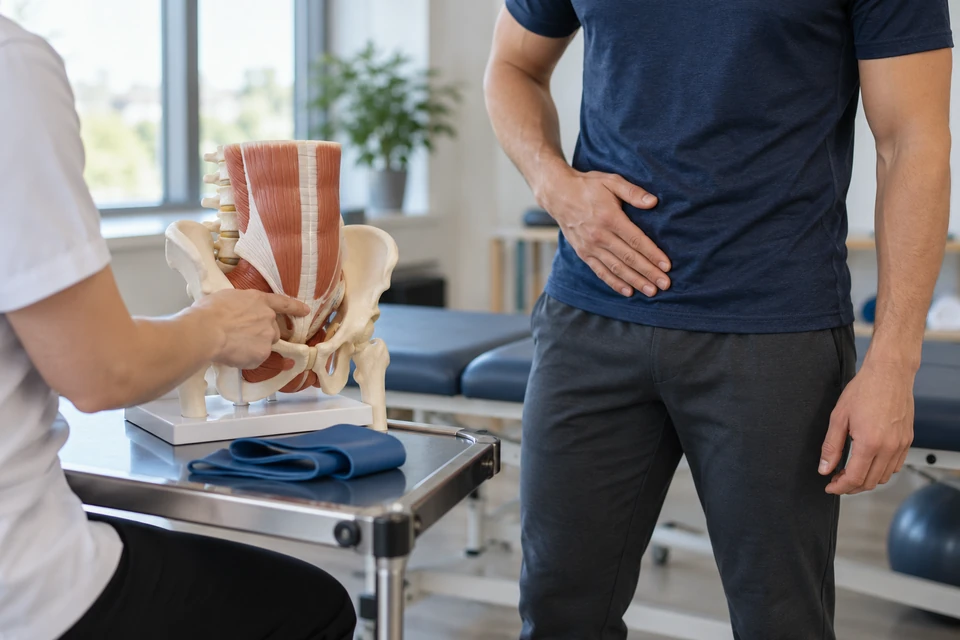
Sports hernia is an imprecise everyday term. Many affected people have no hernia sac or protrusion of abdominal contents. Pain may involve lower abdominal, groin or pubic muscle and tendon structures, often aggravated by turning, kicking or changing direction. Activity-related pain alone does not establish the diagnosis. Adductor, hip, pubic, nerve-related and true hernia problems can overlap.
Examination and differential diagnosis
Assessment reviews sport, workload changes, injury and provoking movements. Examination can include the abdomen, groin, hip and adductors, with resisted tests helping localise pain. Ultrasound or MRI may assess suspected structures and alternatives, but an imaging abnormality is not automatically the pain generator. Testicular, urinary or abdominal symptoms need separate consideration, sometimes through a multidisciplinary assessment.
The central role of rehabilitation
Initial treatment usually adjusts provoking loads and introduces individualised rehabilitation. Trunk, hip and adductor strength, movement control and flexibility may all matter. Load progression avoids both unnecessary complete inactivity and repeatedly training through significant pain. Medication is selected according to health and other medicines. Progress is judged through function and tolerance of sport-specific tasks, with reassessment if improvement is inadequate.
When surgery may be considered
Surgery may be discussed for selected patients with persistent functional limitation despite appropriate rehabilitation and a consistent diagnosis. Procedures vary with the implicated structures and do not automatically require mesh. A coexisting true hernia needs its own assessment. Hip or adductor problems may influence results. The proposed target and symptoms expected to improve should be explained before choosing an operation.
Risks and uncertainty of outcome
Operative risks include bleeding, infection, nerve irritation, numbness, persistent pain and further procedures. Multiple pain sources can limit improvement. Because sports hernia covers different clinical problems, one success figure is not applicable to everyone. Rehabilitation remains necessary after surgery. The wish to return quickly should not override diagnosis, tissue recovery and restoration of strength and control.
Planning return to sport
Return may progress from daily activity to running, directional changes and sport-specific loading. Pain, strength, movement quality and the next day's response guide progression. Training and competition demands differ, so fixed timetables are inappropriate. After surgery, wound recovery and procedural restrictions are integrated with rehabilitation. Recurrent pain should prompt reassessment rather than continued escalation of load.
Symptoms requiring urgent assessment
Sudden severe testicular pain, a painful irreducible groin lump, vomiting or abdominal swelling should not be dismissed as a sports injury. Fever, spreading redness or inability to bear weight after trauma also require assessment. Report worsening pain, wound discharge or urinary difficulty after surgery. Chest pain, breathlessness or fainting need emergency care; a previous sports-related diagnosis does not explain every new symptom.
This information is general. The cause of symptoms, appropriate investigations and treatment options are determined through individual assessment.