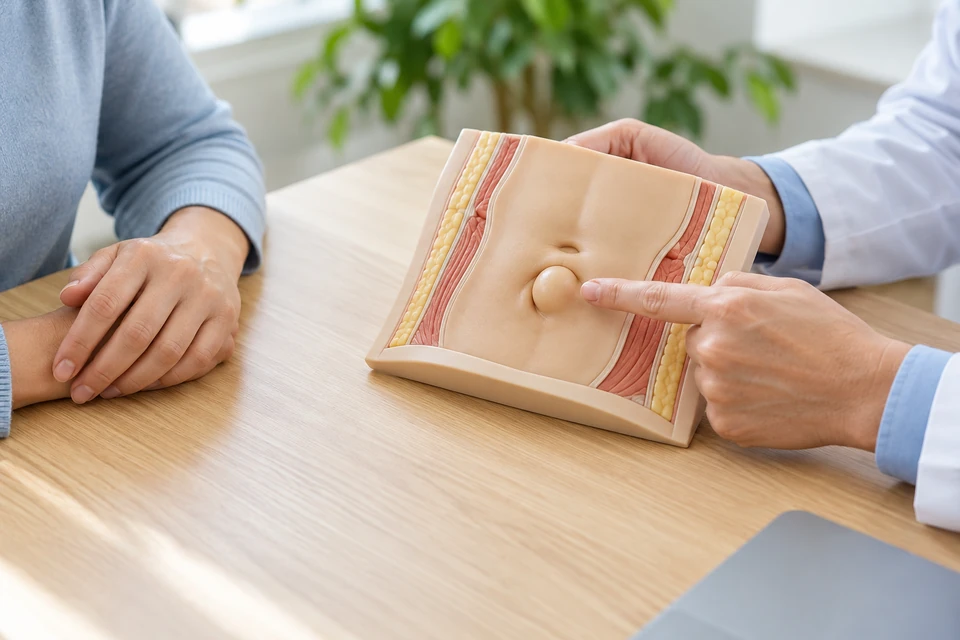
Umbilical hernia in adults
An umbilical hernia is protrusion of fat or bowel through a weakness at the navel. It may cause a lump, pressure or tenderness with coughing or straining. Unlike many childhood hernias, an adult defect is not expected to close by itself. Pregnancy, weight changes and abdominal fluid matter. A previous umbilical incision or associated rectus diastasis can require a different assessment.
Assessment and special circumstances
Examination assesses the defect, contents, tenderness and reducibility. Imaging may help when uncertain or for broader abdominal-wall planning. Liver disease with ascites, diabetes, smoking, previous operations and future pregnancy can influence risk and recurrence. The visible bulge and actual defect are not necessarily the same size. Symptoms and tissue structure, including diastasis, guide the plan beyond appearance alone.
Observation or repair
Repair may be considered for pain, growth or interference with daily life. Selected minimally symptomatic patients may discuss observation with clear warning signs. Pregnancy plans or uncontrolled ascites can alter timing. Optimising weight and other conditions may improve operative circumstances but does not close the defect. A support garment is not a repair, and childhood expectations should not be applied to adults.
Suture and mesh repair
Surgery assesses and returns the contents, then closes the abdominal-wall defect. Suture alone or mesh reinforcement is chosen according to size, tissue quality and recurrence risk. Mesh reduces recurrence in many adult repairs but is not an identical decision in every setting. Open or minimally invasive access is selected individually. Emergency bowel compromise or contamination can change the repair strategy.
Risks and recurrence
Complications include bleeding, infection, fluid collection, wound problems, pain and recurrence. Mesh-related issues and uncommon bowel injury are discussed according to the procedure. Smoking, poorly controlled diabetes and ascites can affect healing. An early postoperative swelling is not always recurrence, but a new enlarging or painful lump needs examination. Risks should be explained using the individual's circumstances.
Preparation and aftercare
Preparation may address glucose control, cough, constipation and ascites, with support for smoking cessation. Follow medication and fasting instructions. After surgery, care includes pain relief, wound care and safe activity. Lifting, work and exercise depend on the repair and progress. Follow-up reviews pain and swelling, while future pregnancy or major weight changes may be relevant to longer-term planning.
Signs of trapping or strangulation
A suddenly hard, very painful and irreducible umbilical lump may need emergency assessment. Vomiting, distension, inability to pass gas or skin discolouration increase concern. Do not force it back or bind it tightly. After repair, report fever, spreading redness, offensive discharge or increasing pain. Breathlessness, chest pain, heavy bleeding or fainting require urgent help, even if the original hernia was small.
This information is general. The cause of symptoms, appropriate investigations and treatment options are determined through individual assessment.