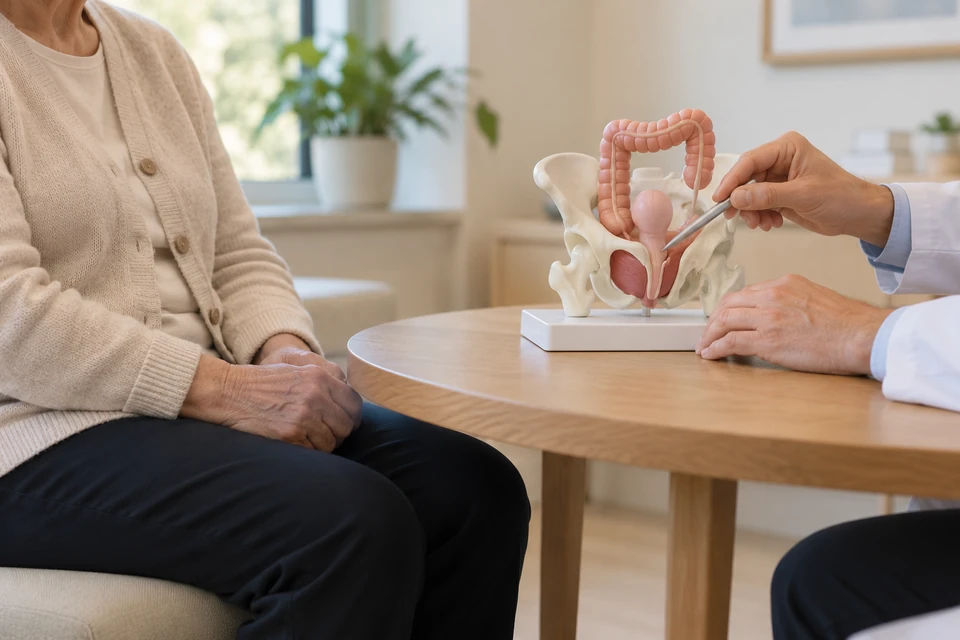
What rectal prolapse means
Rectal prolapse occurs when the rectal wall slips down and may protrude through the anus. Full-thickness prolapse differs from mucosal prolapse and internal folding without external protrusion. Haemorrhoids can also protrude but require different treatment. Symptoms may include mucus, bleeding, hygiene difficulties, constipation and leakage. Examination is needed to identify the type and extent rather than relying on appearance alone.
Bowel and pelvic-floor assessment
Assessment may involve observing prolapse during straining and reviewing constipation, evacuation difficulties, leakage and previous pelvic surgery. Colonoscopy, defaecography or sphincter tests are selected when useful, not automatically performed in everyone. Other pelvic-floor problems, such as bladder or vaginal prolapse, may coexist. Understanding function as well as anatomy helps compare abdominal and perineal approaches.
What nonsurgical support can achieve
Improving stool consistency, reducing straining and pelvic-floor support can ease some symptoms. They do not usually provide a permanent anatomical correction of adult full-thickness external prolapse. Surgery is commonly needed for that purpose. High-risk patients may choose a symptom-management plan. Internal prolapse requires a different assessment, and an imaging finding alone does not automatically justify surgery.
Surgical options
Abdominal rectopexy restores and fixes the rectum, sometimes with bowel resection. Some techniques use mesh, which introduces specific risks that require discussion. Perineal procedures operate through the anal region and suit selected patients. Choice depends on fitness, constipation, continence, anatomy and previous surgery, not age alone. Recurrence and functional trade-offs differ; no single procedure is best for everyone.
Risks and functional expectations
Alongside bleeding, infection, clots and anaesthetic risks, complications depend on the procedure. Resection introduces a leakage risk; mesh has its own possible complications. Constipation may improve, persist or worsen. Continence may remain impaired despite correction because muscle and nerve function also matter. Recurrence is possible. Anatomical repair should therefore be discussed separately from the likelihood of complete symptom relief.
Preparation and recovery
Preparation addresses stool consistency, nutrition, medication and other conditions. Use bowel preparation only as instructed. Afterwards, an individual plan reduces straining while avoiding excessively hard or liquid stools. Activity advice reflects the operation. Pelvic-floor rehabilitation may help selected patients. Report recurrent protrusion, persistent evacuation difficulties or leakage at follow-up; these symptoms deserve practical support rather than being left unmentioned.
Trapped or painful prolapse
A prolapse that becomes trapped, very painful, swollen or dark purple needs urgent assessment because its blood supply may be threatened. Heavy bleeding, fever, abdominal swelling or vomiting also warrant help. Do not force painful, discoloured tissue back at home. After surgery, report increasing pain, fever or inability to pass stool. New severe symptoms require reassessment even if previous episodes were manageable.
This information is general. The cause of symptoms, appropriate investigations and treatment options are determined through individual assessment.