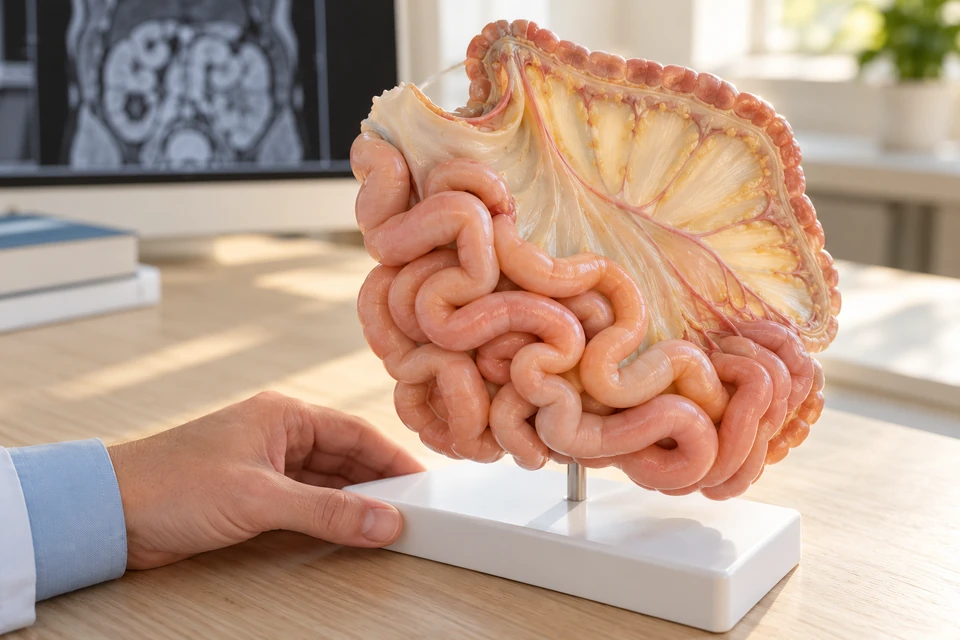
Conditions that may need surgery
The small bowel absorbs nutrients and fluid. Surgery may be needed for a tumour, persistent obstruction, a strangulated hernia, loss of blood supply, injury or selected complications of Crohn's disease. Not every operation removes bowel: adhesions can sometimes be divided or selected narrowings treated while preserving length. The extent depends on tissue viability and disease distribution, with emergencies requiring different decisions from planned surgery.
Assessment and imaging
Assessment considers pain, vomiting, passage of gas and stool, weight loss and earlier operations. Examination, blood tests and imaging help locate an obstruction and assess possible compromised blood supply. CT is often useful in emergencies; elective investigations vary by disease. Some tests, including capsule endoscopy, may be unsuitable with suspected significant narrowing. Previous resections, a stoma, kidney function and nutrition affect planning.
Limits of nonsurgical management
Selected obstructions can improve with monitored hospital care, intravenous fluids and decompression when needed. Medicines are important in Crohn's disease, but a fixed narrowing, abscess or fistula may need another approach. Suspected loss of blood supply, perforation or deterioration can make delay unsafe. Decisions depend on repeated assessment, not one symptom. Significant obstruction should not be managed at home with improvised treatments.
What happens during surgery
The surgeon treats the underlying cause and checks bowel viability. Diseased tissue is removed when necessary, and the remaining ends are joined if safe. A stoma or staged operation may be needed instead. Uncertain viability can require a second assessment in theatre. Access depends on urgency, distension and previous surgery. Pathology of removed tissue helps guide subsequent treatment, especially for tumours or inflammatory disease.
Absorption and short bowel risk
Leakage, infection, bleeding and later adhesional obstruction are operative risks. Extensive or repeated resection can leave insufficient absorptive capacity, causing short bowel syndrome. Risk depends on which bowel remains and whether the colon is connected, not length alone. Diarrhoea, weight loss, deficiencies and dehydration may follow. Bowel preservation and specialist nutritional support therefore form important parts of both surgery and longer-term care.
Preparation and recovery planning
Planned care addresses weight loss and nutritional deficits; emergency treatment first stabilises circulation and fluid balance. Postoperative nutrition depends on remaining bowel function and tolerance, sometimes requiring specialised support. At home, monitor weight, bowel or stoma output and urine changes. Supplements and medicines should follow assessment rather than guesswork. A single standard diet cannot meet the needs of every small-bowel operation.
Warning signs needing prompt assessment
Increasing pain, persistent vomiting, marked swelling and inability to pass gas may indicate obstruction or another complication. Fever, palpitations, faintness, very little urine or rapid deterioration require urgent assessment. Persistent watery output and weight loss need review even if bowel habits were expected to change. With a stoma, report abrupt output changes. Similarity to an earlier episode does not establish that waiting is safe.
This information is general. The cause of symptoms, appropriate investigations and treatment options are determined through individual assessment.