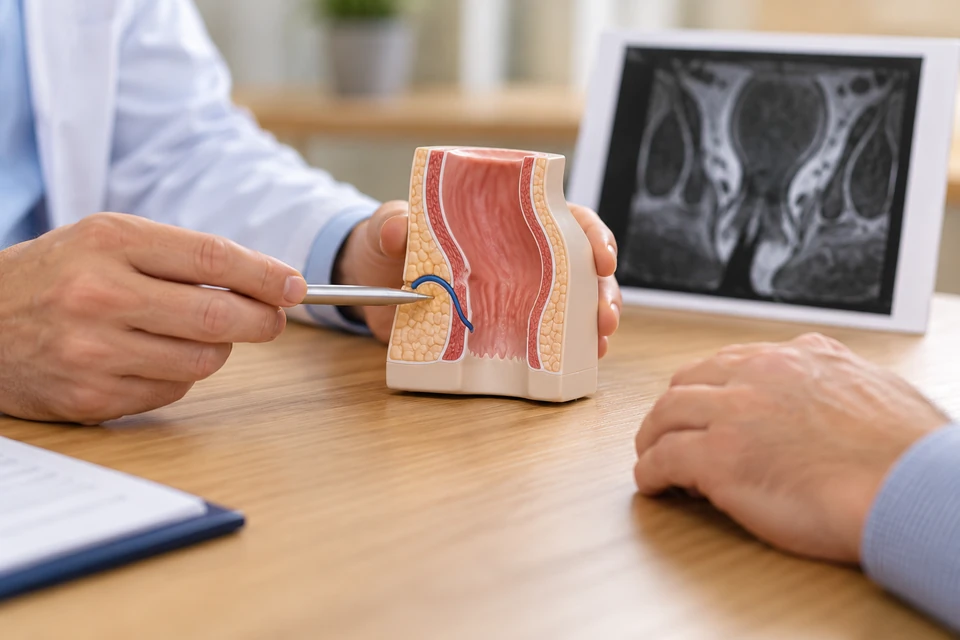
How a fistula develops
An anal fistula often develops after an abscess, leaving a tract between the bowel and nearby skin. Drainage, a small opening, swelling and intermittent pain are common. Closure of the skin opening does not always mean healing; infection can collect again. Some fistulas relate to Crohn's disease or other causes. They differ from haemorrhoids, fissures and pilonidal disease.
Mapping the tract
Examination assesses openings, scars, drainage and sphincter function. Report existing leakage, obstetric injury and prior anal surgery. Straightforward fistulas may not need detailed imaging, whereas recurrent, complex or deep disease can benefit from MRI or selected ultrasound. Examination under anaesthesia may be needed. Mapping identifies muscle involvement and hidden abscesses, while associated bowel symptoms may prompt evaluation for Crohn's disease.
Controlling infection and choosing treatment
An active abscess needs drainage and infection control first. Antibiotics alone do not usually close a typical fistula, though they may be added for selected infections. Crohn-related disease often requires coordinated medical and surgical treatment. A loose seton can maintain drainage without necessarily providing definitive closure. The later strategy depends on tract complexity, muscle involvement and the individual's continence risk.
Differences between procedures
Fistulotomy opens a suitable low tract to heal from its base. When more sphincter is involved, options may include LIFT or an advancement flap to preserve muscle. Treatment sometimes requires stages. Laser, endoscopic and other approaches have differing evidence and suitability. Identifying the internal opening, branches and baseline muscle function matters more than a technique's name; a single-session cure cannot always be predicted.
Main risks
Risks include persistent or recurrent fistula, another abscess, bleeding, pain and healing problems. Altered gas or stool control is a major consideration. Prior operations, a high tract and pre-existing leakage affect risk. Sphincter-preserving methods can still fail or require further procedures. Treatment balances healing with function. New leakage or unexpectedly heavy drainage after surgery should be reported rather than left unmentioned.
Preparation and wound care
Bring previous reports and a full medication list. Preparation depends on the planned procedure. Aftercare may include pads for drainage, gentle cleansing and stool regulation. Do not pull or remove a seton yourself; follow its care instructions. Monitor the wound and drainage pattern. Work and exercise depend on symptoms and healing, with continued gastroenterology follow-up when Crohn's disease is present.
Signs of a new abscess or infection
Increasing pain, new swelling, fever, shivering or worsening wellbeing may indicate another abscess. Drainage stopping while pain increases can mean the tract has blocked. Urinary difficulty, spreading redness or severe weakness require urgent help. Heavy bleeding or faintness needs emergency assessment. Do not probe, squeeze or inject substances into the tract at home; recurrence remains possible even after previous treatment.
This information is general. The cause of symptoms, appropriate investigations and treatment options are determined through individual assessment.