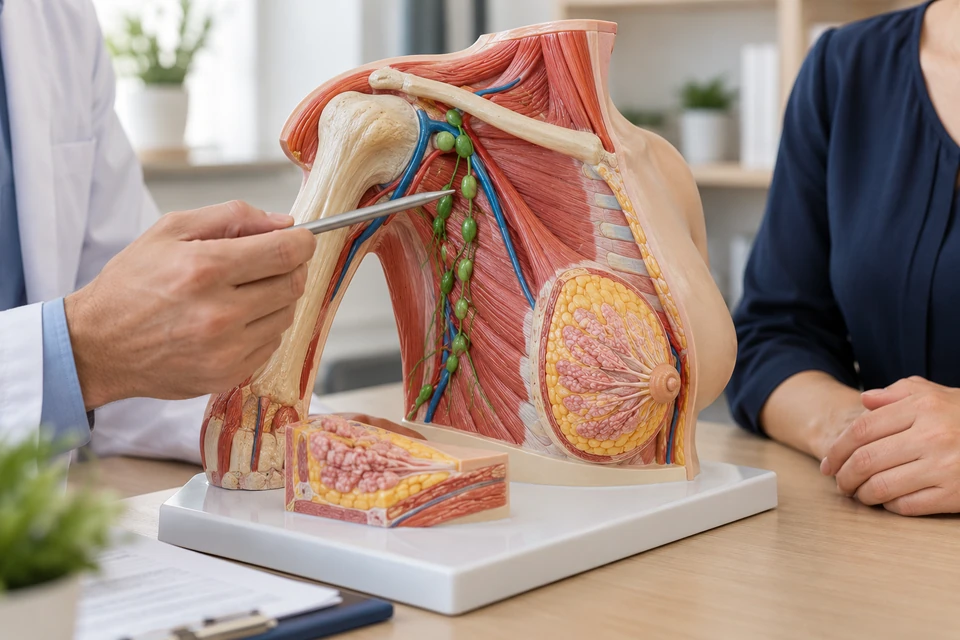
Why assess the lymph nodes?
Axillary nodes are part of the immune system and may enlarge for several reasons, including infection or a recent vaccination. Enlargement does not itself diagnose cancer. In breast cancer, nodal assessment informs staging and treatment. The aim is not automatically to remove every node but to answer a specific clinical question.
Needle biopsy versus sentinel biopsy
A suspicious node seen on ultrasound may be sampled with a fine or core needle. Sentinel-node biopsy identifies and surgically samples the first draining nodes for staging in suitable patients. Axillary dissection is more extensive. These procedures should not be treated as interchangeable because their purposes and complication risks differ.
Assessment before sampling
Planning considers the breast diagnosis, ultrasound, previous biopsies and systemic treatment. A sampled node may be marked before preoperative treatment to help locate it later. Report recent infections or vaccinations. Selected low-risk patients may avoid some nodal surgery when the result would not change management, but eligibility requires individual assessment.
How sentinel-node biopsy is performed
A tracer, dye or other suitable mapping method helps identify the first draining nodes. They are removed through a small incision and sent for pathology. Report allergies, possible pregnancy and previous breast or axillary procedures. The biopsy is often coordinated with breast surgery, but its timing depends on the treatment sequence.
Does a positive result mean more surgery?
Cancer in a sampled node does not automatically require complete axillary dissection. The amount of involvement, breast operation, radiotherapy and previous systemic treatment all matter. Some patients need further surgery and others do not. A positive or negative label must be interpreted within the complete pathology and treatment plan.
Possible risks
Needle sampling may cause bruising, bleeding or tenderness. Surgical biopsy can cause infection, fluid collection, numbness, shoulder restriction or lymphoedema. Sentinel biopsy generally has a lower burden than dissection but is not risk-free. Mapping agents can rarely cause allergic reactions. Existing arm swelling or shoulder problems should be documented.
Preparation and arm care
Discuss medicines and allergies before the procedure. Afterwards, follow the recommended movement plan rather than keeping the arm completely immobile. Skin care and recognition of swelling or infection are important. Persistent discomfort or limited movement may warrant physiotherapy. Return to activity also depends on the associated breast operation.
Follow-up and early warning signs
Pathology is reviewed together with the breast findings to determine further treatment. Report new arm or hand swelling, heaviness, reduced movement or skin redness early. Fever with rapidly spreading redness needs urgent assessment. Follow-up should address arm function and daily life as well as cancer management.
This information is general. The cause of symptoms, appropriate investigations and treatment options are determined through individual assessment.